A young name for an old claim, spoken in every tongue as the land where the sun goes down.
“It shall be one day which shall be known to the LORD, not day, nor night: but it shall come to pass, that at evening time it shall be light.”
Zechariah 14:7
▰ Spine▱ Scaffold◇ Conviction✧ Wink◈ Witness
The thesis, in short
"Western Civilization" is a 19th-century phrase. It was a college course by 1919 and a creed spoken from the by 2026. Beneath it lie older names: the Latin , "the falling," and the German , "the evening land." Latin Christianity was one enduring historical influence, while the borders, peoples, and geography called "the West" changed over time. Ancient continental divisions, Greek reference meridians, medieval schematic maps, and the author's proposed modern corridor are related readings, not one continuous boundary. The word Abendland is attested in the 1520s. In those same years the land of the Plumed Serpent fell to a Christian king, and Europe's peasants fell to its princes. The conviction held here is that those years opened a long night that lasted until 2025, and that the evening land's day has now ended.
— I · The Words —
Named for the Going Down
Four tongues, one picture: the West is where the light leaves.
TONGUETHE MORNING LANDTHE EVENING LAND
Hebrew ▸קֶדֶם · east; before, of oldעֶרֶב · evening
Greek ▸ἀνατολή · risingἙσπερία · evening land
Latin ▸oriensoccidens
German ▾MorgenlandAbendland
Luther put Morgenland into Matthew 2:1 in 1522. Within 7 years Kaspar Hedio, a Strasbourg reformer, is cited for Abendländer, the evening lands, in 1529. That is the autumn the Ottoman army stood before Vienna.
In every tongue the West is named for the hour the light leaves. Tap a row.
Text transcript · all language rows
Hebrew: East—קֶדֶם (east; before, of old); West—עֶרֶב (evening). Hebrew faces the sunrise. The East is qedem, the word for what came before, so the past lies in front of you and the West is behind your back. 'Ereb is the evening of 'the evening and the morning were the first day': in the biblical day, evening comes first and morning closes it. This panel pairs direction with evening imagery; it does not identify 'ereb as the ordinary Hebrew word for the direction west. Source 1.
Greek: East—ἀνατολή (rising); West—Ἑσπερία (evening land). The magi came 'from the risings,' apo anatolōn (Matt 2:1), and Zacharias calls the coming Christ the anatolē, 'the dayspring from on high' (Luke 1:78). For the Greeks, Hesperia lay over the western water: Italy first, then Spain. Source 28.
Latin: East—oriens (rising); West—occidens (falling, going down). Occidere means 'to fall' and also 'to die.' The Occident is literally 'the falling,' the quarter where the sun goes down. Latin remained one enduring historical influence, while its reach and the geography called 'the West' changed across periods; it does not define one unchanging boundary. Source 42.
German: East—Morgenland (morning land); West—Abendland (evening land). Luther put Morgenland into Matthew 2:1 in 1522. Within 7 years Kaspar Hedio, a Strasbourg reformer, is cited for Abendländer, the evening lands, in 1529. That is the autumn the Ottoman army stood before Vienna. Source 2.
The East is a rising; the West is a falling▰ Spine
In Latin the East is , "rising," and the West is , from occidere, "to fall, to die." Greek uses the same picture: for the rising and for the settings. "Many shall come from the east and west, and shall sit down with Abraham" (Matt 8:11). Western Christian usage helped carry this directional language; its histories do not establish one unchanging territorial boundary.
Morgenland, then Abendland▰ Spine
In his 1522 New Testament Luther wrote "Da kamen die Weisen vom Morgenland," "there came wise men from the morning land." The evening-land word followed within the decade: Kaspar Hedio, a Strasbourg reformer, is cited for Abendländer in 1529. German now had a pair, and the pair cast Europe as the land of evening.
Evening comes first▱ Scaffold
In Scripture the day begins at evening: "the evening and the morning were the first day" (Gen 1:5). An evening land is not where the story ends. On the biblical reckoning, evening is where a new day begins, and morning is how it is completed.
— II · Before the Name —
Latin Christendom
The thing existed for 700 years before anyone called it 'Western Civilization.'
A Roman crown, a European father▰ Spine
About 799, a court poet at Paderborn hailed Charlemagne as rex, pater Europae, "king, father of Europe." On Christmas Day 800, Pope Leo III crowned him emperor in Rome. This is one early, documented Latin-Christian European self-description—not Europe's first self-portrait or the first European boundary.
The schism draws the line▰ Spine
In 1054 the papal legate and the Patriarch of Constantinople excommunicated each other. That became a marker within a much longer and more complex history of Latin and Greek Christian divisions; it was not the first East–West boundary. When crusaders sacked Constantinople in 1204, the divisions were enforced with the sword. In the 13th century the Latin side called itself , Christendom.
The boundary tracks Rome▱ Scaffold
Across some periods, Latin ecclesial influence helped shape claims about a western boundary, but the geography shifted and never formed one unchanged line. Borders between Poland and Russia, Croatia and Serbia, and Hungary and Orthodox lands are examples from distinct histories, not a fixed frontier. Names such as Christendom, Europe, civilisation, and the West overlapped without being interchangeable.
The cloister and the curia◈ Witness
For the long Latin centuries this boundary enclosed, see the companion exhibit The Monastic Age.
— III · Ancient Geography —
Continents, Meridians, and Schematic Maps
Different ancient and medieval systems—not one timeless boundary.
The quarrel begins at a line▰ Spine
Herodotus opens his history with a dispute over the continents. The Persians, he says, claim Asia as their own, while "Europe and the Hellenic race they consider to be parted off from them" (1.4). His account gives the Nile as the division between Asia and Libya (Africa); farther north, the Phasis—or, some say, the and the Cimmerian straits—mark debated limits (4.45). These are ancient continental divisions, not a single Europe–Asia line at the Nile.
The meridian the Greeks measured the world by▰ Spine
Eratosthenes used a through Meroë, Syene, Alexandria, Rhodes, and the Troad. Hipparchus marked his "on the meridian through Meroë," with reference stations including Syene, Alexandria, Rhodes, Byzantium, the , and the mouth of the Borysthenes, the Dnieper. This is a Greek cartographic and astronomical reference, not the same thing as a political or continental boundary. Ptolemy's coordinates modelled a slant westward; Byzantium appears 4½° west of Alexandria in his system, while the modern longitude gap is about 1°. Byzantine astronomers also expressed positions in hours from Alexandria, and a Constantinople meridian later became influential.
Byzantium
41.01°N · 28.98°E
Hipparchus' station at the Bosporus. Constantine dedicated New Rome here in 330. North–south sea road and east–west land road cross at the city.
True positions. The violet line is Ptolemy's Alexandria-to-Byzantium slant. The gold rule at Rhodes is Eratosthenes' main parallel.
Text transcript · all diagram states and plotted stations
The Greek reference-meridian stations (true modern coordinates plotted; schematic joins)
Meroë — 16.94°N, 33.75°E. Hipparchus measures his bands of latitude 'on the meridian through Meroë.' The line begins at the Nile's upper kingdom. Source 31.
Syene — 24.09°N, 32.90°E. Aswan. At the summer solstice the noon sun stood overhead here. Eratosthenes measured the earth from Syene to Alexandria along this meridian. Source 31.
Cairo — 30.04°N, 31.24°E. The head of the Delta, where the Nile divides. In 1517 Selim I conquered Cairo and removed the last Cairo-based Abbasid caliph. A formal office-transfer to the Ottoman dynasty is a later, disputed tradition. Source 37.
Alexandria — 31.20°N, 29.92°E. The meridian's reference city. Byzantine astronomers gave the positions of other places in hours east or west of Alexandria. Source 32.
Rhodes — 36.43°N, 28.22°E. On Eratosthenes' map the main parallel and the main meridian crossed here. The ancient map of the world was built on a cross. Source 31.
Troy — 39.96°N, 26.24°E. The Troad, near the Hellespont and on the Asian shore. Ancient accounts tell of Xerxes' crossing toward Europe in 480 BC and Alexander's crossing into Asia in 334 BC and honoring Achilles' grave. Source 34.
Byzantium — 41.01°N, 28.98°E. Hipparchus' station at the Bosporus. Constantine dedicated New Rome here in 330. North–south sea road and east–west land road cross at the city. Source 31.
Borysthenes — 46.60°N, 31.90°E. The mouth of the Dnieper, Hipparchus' northern station, and the start of the river road north. Source 31.
Kyiv — 50.45°N, 30.52°E. On the road 'from the Varangians to the Greeks.' Baptized from Constantinople in 988; the faith travelled north up the meridian. Source 35.
Pulkovo — 59.77°N, 30.33°E. The observatory south of St Petersburg whose meridian, 30°19′E, was Russia's prime meridian in the 19th century. Source 35.
The T-O schematic
Medieval east-up schematic. With east at the top, Asia occupies the upper region; Europe and Africa share the lower half, divided by the Great Sea. In Isidore's description, the Nile divides Asia from Libya/Africa, not Europe from Asia. The modern Constantinople point at the joint is an overlay added for this exhibit, not an ancient placement or a standard feature of medieval T-O maps. Source 33.
Modern north-up overlay. Rotating the same schematic north-up turns its divider sideways: the Don and Nile are shown at north/south ends, the Mediterranean extends west, and Asia lies east. The Cairo-to-Constantinople route is an interpretive modern overlay, not an ancient continental boundary or a route encoded in a medieval T-O diagram. Source 33.
The crossbar of the T▰ Spine
Isidore of Seville describes Asia as half the world, divided from Libya/Africa by the Nile, with Europe and Africa sharing the other half. Medieval T-O maps schematized the inhabited world inside an ocean ring, often with the Mediterranean as the stem and crosswaters represented by the Don and Nile; orientation and geographic details vary, and Jerusalem is often central. This diagram shows one east-up schematic; its Constantinople-at-the-joint point is a modern overlay, not an ancient placement or a feature common to the medieval map tradition. The T-O map is not an ancient Europe–Asia boundary.
The crossings▰ Spine
Ancient authors tell of crossings at the Hellespont, treated in some Greek narratives as a passage between Asia and Europe. Troy stood on its Asian shore. Xerxes bridged the Hellespont in 480 BC and had the water lashed when a storm broke the first bridge. After Salamis, Plutarch has Themistocles propose breaking that bridge "that we may capture Asia in Europe." Aristides answers that they should build a second one "and cast the fellow out of Europe." In 334 BC Alexander crossed the other way, sacrificed at Ilium, and anointed the grave of Achilles. In 330 Constantine set New Rome on the Bosporus. In 988 Kyiv took its baptism from Constantinople, and the faith travelled north up the Dnieper road, the route "from the Varangians to the Greeks." The later Pulkovo meridian is a distinct reference system, not the road's destination or ancient extension.
The speech on the Pnyx told the story of this line▱ Scaffold
The Athens speech's ancient references are documented as a modern speaker's selection of exemplars, including Alexander, Caesar, Charlemagne, and Cortés; press accounts report other classical references as well. Reading these examples as one continuous Europe–Asia boundary or as an announced season is interpretive linkage, not an ancient source's stated scheme.
The joint▱ Scaffold
The Cairo–Constantinople corridor is the author's modern interpretive overlay, not a Greek meridian, an ancient Europe–Asia boundary, or a medieval T-O map's historical placement. Selim I conquered Cairo in 1517 and removed its last Abbasid caliph; the formal transfer of the caliphal office to the Ottoman dynasty is a later, disputed tradition. The companion exhibit The City Between the Seas follows the claimed custody reading from 1517 to 1924.
This is the spine of the East, not the Latin border▱ Scaffold
The late Roman administrative division of 395, later Latin–Greek ecclesial divisions, ancient continental accounts, Greek reference meridians, and medieval T-O schematics are separate historical geographies. The Cairo–Constantinople-to-north corridor shown here is the author's modern synthesis, not an unchanged ancient line.
— IV · The Dial —
The Sun Across the Centuries
Step through the record and watch the light over the evening land.
1525 · One year, two worlds▰ Spine
In February 1525 Cuauhtémoc, the last Mexica ruler, is hanged on Cortés's march to Honduras. That same month, at Pavia, Charles V captures the king of France. In May the peasant army is destroyed at Frankenhausen, and Luther writes against the 'murderous, thieving hordes.'
The dated events are Spine. The sun's course is the house's conviction.
Text transcript · every dated dial event
800 · Father of Europe — In the Paderborn Epic of about 799, Charlemagne is hailed 'rex, pater Europae.' On Christmas Day 800, Pope Leo III crowns him emperor in Rome. This is one documented Carolingian European self-description, not Europe's first self-portrait. Source 4.
1054 · A schism marker — Rome's legate and the Patriarch of Constantinople excommunicate each other. This episode later became a marker in Latin–Greek divisions; it did not create the first East–West boundary, which long predates it, and the schism's history was gradual. Source 5.
1200s · Christianitas — Under Innocent III and his successors, christianitas, Christendom, names the society under the Latin Church. The crusaders' sack of Constantinople in 1204 shows how far the Latins now counted the Greeks as outsiders. Source 5.
1521 · The Plumed Serpent's city falls — Cortés lands on the Gulf coast in April 1519. Tenochtitlan falls on 13 August 1521. The land of Quetzalcoatl, the Plumed Serpent, passes to the crown of Castile. Source 6.
1525 · One year, two worlds — In February 1525 Cuauhtémoc, the last Mexica ruler, is hanged on Cortés's march to Honduras. That same month, at Pavia, Charles V captures the king of France. In May the peasant army is destroyed at Frankenhausen, and Luther writes against the 'murderous, thieving hordes.' Source 8.
1529 · The evening lands, named — Kaspar Hedio is cited for Abendländer, the counterpart to Luther's Morgenland of 1522. In the autumn of 1529 Suleiman's army besieges Vienna, and the morning land is at the gate. Source 2.
1756 · The word civilisation — Mirabeau's L'Ami des hommes is associated with the modern noun civilisation around 1756/57, depending on work, publication, and attestation. The noun first names a process of becoming civil; no absolute first-use claim is made, and it is not a verb. Source 10.
1799 · Christendom or Europe — Novalis writes Die Christenheit oder Europa, a lament for the 'beautiful, shining times when Europe was a Christian land.' The lost Latin unity becomes a thing to mourn. Source 11.
1828 · One story of civilisation — Guizot's lectures at the Sorbonne make civilisation a single European plot running from Rome through the Church to the modern state. The process now has a home address. Source 12.
1840s · 'Western civilization' in English — The English phrase spreads from the mid-19th century and is in common use by its close, as Britain's empire and Europe's scramble for Africa reach their widest extent. Source 13.
1902 · A title-page term — Benjamin Kidd publishes Principles of Western Civilisation. The phrase now marks an imperial sociology, with the English-speaking peoples leading the advance. Source 14.
1918 · The going-under — Spengler's Der Untergang des Abendlandes appears in the last summer of the war. Reading Untergang as the setting sun makes an evocative wordplay on the evening land; it is not a uniquely determined literal translation. Source 15.
1919 · A course is born — Columbia turns its wartime War Issues Course into Contemporary Civilization. American colleges follow with 'Western Civ' surveys, a single line from Athens to Washington taught to every freshman. Source 16.
1920 · Three carriers in one year — Belloc: 'The Faith is Europe. And Europe is the Faith.' Stoddard: The Rising Tide of Color, the West recast as a race under siege. In 1925 Hermann Platz's Abendland gathers a Catholic circle around the old name. Source 17.
1987 · 'Western Civ has got to go' — Stanford had required Western Civilization since 1935. It dropped the requirement in 1969 and restored it as Western Culture in 1980. After the January 1987 protest chant, it replaced the course in 1988. The name had become a flag in a culture war. Source 20.
1993 · Civilizations, plural — Huntington's 'The Clash of Civilizations?' recasts the West as one of 7 or 8 blocs, its fault lines running against Orthodoxy and Islam. The 'East' moves again. Source 21.
2017 · 'The will to survive' — In Warsaw, President Trump: 'The fundamental question of our time is whether the West has the will to survive.' Source 22.
Feb 2026 · Munich — Secretary Rubio's Munich address, framed by the White House as an 'unapologetic defense of Western civilization' drawing on 'Europe's profound Christian foundations.' Source 23.
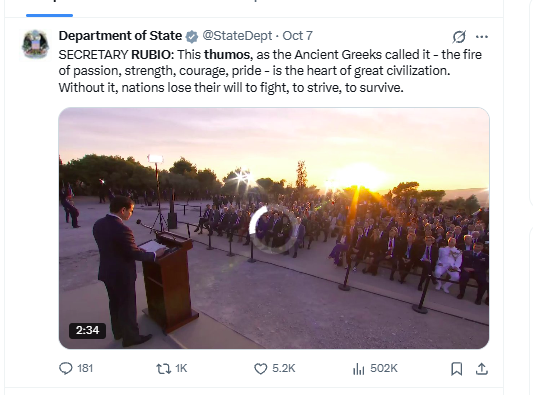
Oct 2026 · The Pnyx — Official transcript: Rubio calls thumos 'the fire of passion, strength, courage, pride' and the heart of great civilization; without it, nations lose the will to fight, strive, and survive. He says qualities seen in Alexander reappeared in Caesar, Charlemagne, and Cortés. The State Department separately centered thumos in its Oct. 7 social amplification (source 38). The speech's civilizational argument and the exhibit's warning are interpretations, distinct from these documented words. Source 24.
— V · 1519–1529 —
The Plumed Serpent and the Evening Land
The decade that named the West.
The land of the feathered serpent▰ Spine
means "feathered serpent," and he was one of the great gods of central Mexico. Cortés landed on the Gulf coast in April 1519, and Tenochtitlan fell on 13 August 1521. Spanish chronicles later said that Moctezuma took Cortés for the Plumed Serpent come back from the east. Historians dispute whether the Mexica ever believed this or whether the story was written into the record after the conquest.
1525▰ Spine
In February 1525, on Cortés's march to Honduras, Cuauhtémoc, the last Mexica ruler, was hanged. That same month, at Pavia, the army of Charles V, emperor and king of Spain, captured the king of France. In May the peasant army of Germany was destroyed at Frankenhausen, and Luther published his tract against the "murderous, thieving hordes." In a single season the crown that held the New World became master of the Old, and the commons of the Reformation lands were put back under their lords.
1529▰ Spine
Four years later an attestation is cited for Abendländer, the evening lands. That autumn Suleiman besieged Vienna. In the house's reading, the name resonates with an expanding Atlantic world; chronology alone does not establish a single act of self-naming or a causal link.
Who named whom▱ Scaffold
On the house's reading, the attested Abendland forms resonate with an Atlantic empire taking shape. That timing is a proposed relation, not evidence that the term was coined at that moment or solely meant a realm beyond the sunset.
— VI · 1756–1920 —
The Word Is Coined
From a process to a bloc to a course.
Civilisation: a noun for a process▰ Spine
The French noun named a process of becoming civil before it also named a condition or collective. Its association with Mirabeau is dated to 1756/57 depending on work, publication, and attestation; its absolute first-use status is challenged. In 1799 Novalis mourned the lost unity of Christendom: "beautiful, shining times, when Europe was a Christian land." By 1828 Guizot was lecturing on the civilisation of Europe as a single plot running from Rome to the modern state.
The phrase arrives with the empires▰ Spine
"Western civilization" spread in English from the mid-19th century and was common by its close, the decades of the Raj and the scramble for Africa. In 1902 Benjamin Kidd put it on a title page, Principles of Western Civilisation, with the English-speaking peoples leading its advance.
The sunset book▰ Spine
In 1918 Spengler published Der Untergang des Abendlandes. It is usually translated "The Decline of the West." also evokes the sun going under, making sunset wordplay with Abendland; that is not a uniquely determined literal translation.
1919–1925: the course and the creeds▰ Spine
Columbia turned its wartime War Issues Course into Contemporary Civilization in 1919, and "Western Civ" became a freshman requirement across America. In 1920 Belloc wrote: "The Faith is Europe. And Europe is the Faith." In the same year Stoddard's The Rising Tide of Color recast the West as a race under siege. In 1925 Hermann Platz's journal Abendland gathered Catholics around the old German name.
One name, many carriers▱ Scaffold
The name has had several carriers, and each defined its "East" differently: the Greek Church, the Turk, the colonized peoples, a "rising tide," the books not read, Moscow, Islam, Beijing. The carriers disagree with each other, and many of their heirs would reject Stoddard outright. That is the complication, and here it is stated once. The exhibit proposes recurring Latin ecclesial influence in some later western-boundary claims; no line remained fixed through all of them.
The Latin Church800–1500its East: the Greek Eastchristianitas
The Protestant & imperial1525–1914its East: the Turk; the colonizedcivilisation
The racial theorists1900–1945its East: the 'rising tide'race
The college survey1919–1988its East: the un-readthe canon
The cold & civilizational strategists1947–2026its East: Moscow; Islam; Beijingthe bloc
The carriers and boundaries shift; this exhibit argues for a recurring Latin influence, not an unchanged line.
— VII · 1987–2026 —
From Course to Creed
The name leaves the classroom and returns to the podium.
'Western Civ has got to go'▰ Spine
Stanford had required Western Civilization since 1935. It dropped the requirement in 1969, restored it as Western Culture in 1980, and replaced it in 1988 after the protest chant of January 1987. In 1993 Huntington recast the West as one civilization among 7 or 8, with fault lines against Orthodoxy and Islam.
'The will to survive'▰ Spine
Warsaw, 6 July 2017: "The fundamental question of our time is whether the West has the will to survive."
Munich and the Pnyx▰ Spine
On 14 February 2026, Secretary of State Rubio addressed the Munich Security Conference. The White House framed the speech as an "unapologetic defense of Western civilization" drawing on "Europe's profound Christian foundations." On 7 October 2026 he spoke on the Pnyx, with the Parthenon behind him. He traced the West from Greece and Rome through Christendom to America. He said, "We choose the unapologetic pursuit of national power," and that the coming decade "will determine whether the West maintains its place at the head of the world." He also praised Hernán Cortés as an heir of the Athenian spirit.
The thumos passage · transcript and social amplification▰ Spine
The official transcript records Rubio's words: “The , as the ancient Greeks called it – the fire of passion, strength, courage, pride – is the heart of great civilization. And without it? Without it, nations lose their will to fight, the will to strive, the will to survive.” The address continues: “And the qualities that led Alexander to conquer the entire known world reappeared in Caesar, then Charlemagne, and Cortes.” The Department of State then deliberately centered thumos in its own 7 October social amplification—not merely in the speech transcript—foregrounding this Greek term and its civilizational framing.User-supplied screenshot of the Department of State's 7 October post. Displayed engagement counts are part of the supplied capture and are not represented as current. Open the official post · To Vima report.
The biblical wrath vocabulary and the returning cup▰ Spine
The New Testament uses both and for wrath; the lexical entries show their ranges and occurrences. Both are used of God: the seven bowls are "full of the wrath (thumos) of God" (Rev 15:7), and at the end the words are joined, "the fierceness (thumos) of his wrath (orgē)" (Rev 16:19; 19:15). Scripture forbids destructive human anger and outbursts—not every experience of anger—saying, "Let all bitterness, and wrath (thumos), and anger (orgē)… be put away from you" (Eph 4:31; Col 3:8), and "the wrath (orgē) of man worketh not the righteousness of God" (Jas 1:20). The line Scripture draws is not between the words but between human vengeance and God's: "give place unto wrath: for it is written, Vengeance is mine; I will repay, saith the Lord" (Rom 12:19).
Revelation then shows what becomes of a civilization's thumos. Babylon makes the nations drink "the wine of the wrath (thumos) of her fornication" (Rev 14:8; 18:3). Two verses later, whoever drinks it "shall drink of the wine of the wrath (thumos) of God" (Rev 14:10). And the sentence on Babylon is measured in her own vessel: "in the cup which she hath filled fill to her double" (Rev 18:6). The passion poured out returns as judgment, in the same cup and under the same word.
The lexical record and the modern linkage▱ Scaffold
The New Testament lemma occurrences and the State Department's post are documentary SPINE: they establish what the words are and what was published. Linking the modern political call to the scriptural pattern of Babylon's cup is this exhibit's interpretation, not a conclusion supplied by a shared Greek lemma. That distinction does not soften the warning: the house reads the publicly amplified summons to thumos as a grave sign, with divine vengeance and Revelation's returned cup in view.
Cortés, in Athens▱ Scaffold
In 2026 the evening land's champion, speaking on the Pnyx, named as an heir of the Athenian spirit the man who brought down the land of the Plumed Serpent. The lineage that the 1520s began was claimed out loud, in that place.
⟡ Beyond this line: conviction, not evidence ⟡
The record above stands on its own. What follows is how this house reads it.
— VIII · The Long Night —
1525–2025
The evening land's season, and its close.
A night of 500 years◇ Conviction
The conviction held here is that the long night began in 1525 and ended in 2025. Its opening was the season when Cuauhtémoc hanged, Pavia was won, and the peasants fell. Through that night the champions of the evening land held the world's stage. They gathered great prosperity, and it went to relatively few. The capacity to share it at scale existed: the ships, the mills, the presses, the railways, the grids, and in the end the networks. That capacity was not put to the service of the many.
The serpent's departure◇ Conviction
The house holds that in April 2025 the serpent was cast into the lake of fire (Rev 20:10), and that the night ended in that year. The evening land's season is over. What remains is the time between the reigns.
The interregnum of Psalm 110◇ Conviction
"Sit thou at my right hand, until I make thine enemies thy footstool… rule thou in the midst of thine enemies" (Ps 110:1–2). This is the : the King is seated and ruling, and his enemies are still in the room. Daniel saw the same pattern: "As concerning the rest of the beasts, they had their dominion taken away: yet their lives were prolonged for a season and time" (Dan 7:12). The dominion is gone, but the actors are still here. Not everyone who championed the long season will leave the stage voluntarily or in good faith. The reading held here is that this is why the interregnum is ruled from the right hand rather than waited out.
Thumos as fair warning◇ Conviction
The reading held here is that a summons to thumos, spoken from the Pnyx at the close of the long night, is itself a sign: whether knowingly or not, it announces the cup that comes back. Revelation pictures the great men of the earth who understand the hour too late, hiding "in the dens and in the rocks of the mountains" and saying "the great day of his wrath (orgē) is come; and who shall be able to stand?" (Rev 6:15–17). Yet the Lord "is longsuffering to us-ward, not willing that any should perish, but that all should come to repentance" (2 Pet 3:9). The door stands open to the end, including for the mighty. But the end is appointed, and the penalty of defiance is incalculable: the second death (Rev 21:8). Wisdom's last word to those who refuse her is "I also will laugh at your calamity… then shall they call upon me, but I will not answer" (Prov 1:26–28), and the final sentence fixes every state: "He that is unjust, let him be unjust still" (Rev 22:11).
The point is the season, not the persons◇ Conviction
This conviction concerns a season and a structure. It is not a verdict on any individual's heart. Speeches and policies are on the record above. Men's motives are known to God.
— IX · The Notebook —
Winks
Small correspondences, offered lightly.
The sunset of the sunset land✧ Wink
Spengler's Untergang des Abendlandes can be heard as "the going-under of the evening land": evocative sunset wordplay, not a uniquely determined translation.
The serpent in the western garden✧ Wink
The Greeks put the garden of the golden apples at the edge of the evening world. It was kept by the Hesperides, the daughters of Evening, and guarded by a serpent, Ladon. The first "evening land" already had a serpent guarding its gold.
Civilisation at midnight✧ Wink
The midpoint of 1525–2025 is 1775. Civilisation is associated with Mirabeau around 1756/57, and the Atlantic revolutions broke out at 1775–76. The name of the evening land's pride was forming in the middle of its night.
'Ereb and Europa✧ Wink
Some have heard a Semitic word for "evening, going down" in the name Europa. Most linguists doubt it. The Hebrew , "evening," is spelled with the same letters as the 'ereb of the "mixed multitude" that went up out of Egypt (Exod 12:38).
What God winked at, beside the Pnyx✧ Wink
The sits between the Pnyx and the Acropolis. There Paul told the Athenians that God "hath determined the times before appointed, and the bounds of their habitation," and that "the times of this ignorance God winked at; but now commandeth all men every where to repent" (Acts 17:26, 30). A speech on the West's place at the head of the world was given within sight of the rock where the times and bounds of nations were preached as God's to set.
Two crosses on the line✧ Wink
Eratosthenes' map was built on a cross: its main meridian and its main parallel met at Rhodes. At Constantinople the ground makes another. The Bosporus is a north–south sea road, and the land road from Europe into Asia crosses it east to west. Reading that city as the joint of a medieval T-O diagram is this exhibit's modern overlay, not a reproduced ancient placement.
The slant✧ Wink
Ptolemy's numbers bent the meridian westward as it ran north from Alexandria to Byzantium. A line drawn today from Cairo through Constantinople, carried on north, leans the same way toward the Bug, where the Union of Brest (1596) joined part of the Orthodox Church to Rome.
— X · Lord, Send Me —
Children of the Day
The evening land had its season. The saints are given utterance for the morning.
Not of the night◇ Conviction
"Ye are all the children of light, and the children of the day: we are not of the night, nor of darkness" (1 Thess 5:5). The , "the dayspring from on high," has visited us "to give light to them that sit in darkness… to guide our feet into the way of peace" (Luke 1:78–79). The steps below are petitions and practices under the covenant of grace. Each saint receives fresh unction and words fitted to their own place. None of this is a law to keep or a date to watch.
1. Ask for morning words
"The night is far spent, the day is at hand" (Rom 13:12). Ask each morning for utterance fitted to where you stand, and speak of the day rather than rehearsing the night. Write down what is given.
2. Bless the ones leaving the stage
"Bless them which persecute you: bless, and curse not… Be not overcome of evil, but overcome evil with good" (Rom 12:14, 21). Some will not leave willingly. The King rules in their midst, and the saints are not sent to curse them. Name one in your own sphere, pray for them by name, and let the Spirit give the words.
3. Let your capacity serve the many
"He that had gathered much had nothing over; and he that had gathered little had no lack" (2 Cor 8:15). The manna was the type, and the early church lived it: "neither was there any among them that lacked" (Acts 4:34). Ask what in your hands, whether a skill, a tool, a platform, or a surplus, can be opened to many rather than kept for a few. Then do one concrete thing with it this week.
4. Speak on the hill
Paul stood among the philosophers and spoke of the God who "made of one blood all nations of men" (Acts 17:26). When the talk is of civilizations and their rank, ask for words that set the nations' times and bounds back in God's hand, spoken with grace and seasoned with salt (Col 4:6).
5. Rule in the midst
The interregnum is ruled "in the midst of thine enemies" (Ps 110:2), and "thy people shall be willing in the day of thy power" (110:3). Volunteer in the day of his power. Bring what you have been given to the assembly, and receive what others carry (Heb 10:25).
6. Prove what is given
"Prove all things; hold fast that which is good" (1 Thess 5:21). Before publishing an utterance on the times, weigh it against Scripture and lay it before one or two saints you trust.
— ⟡ · The Verdict —
Weighed Honestly
The spine: the four-tongue lexicon of the West as falling and evening; Luther's Morgenland of 1522 and Hedio's cited Abendländer attestation of 1529; Herodotus's distinct continental limits, with the Nile separating Asia from Libya/Africa; the reference-meridian traditions of Eratosthenes and Hipparchus; Isidore's T-O schematic; the crossings at the Hellespont as ancient authors tell them; the Dnieper road and Kyiv's baptism; Charlemagne as "father of Europe" and the schism marker of 1054; the conquest of Tenochtitlan, Cuauhtémoc's death, Pavia, and Frankenhausen in 1525; Mirabeau, Novalis, Guizot, Kidd, Spengler, Columbia, Belloc, Stoddard, and Platz; Stanford, Huntington, Warsaw, Munich, and the Pnyx; the State Department's documented thumos post and New Testament occurrences of thumos and orgē, including the cup returned to Babylon (Rev. 14:8–10; 18:6). Each stands without the reading.
The scaffold: that Latin ecclesial influence recurs in some later western boundary claims; that the Abendland attestation resonates with an Atlantic expansion; that the Pnyx speech's praise of Cortés claims a lineage; and that its ancient references invite comparison with crossings and conflicts described by Greek authors. These are interpretations of the record, not a timeless border or a scheme stated by those ancient sources.
The conviction: that 1525–2025 was the long night of the evening land, its prosperity gathered to relatively few while the capacity to share it existed; that the serpent went to the lake of fire in April 2025; and that we now stand in the interregnum of Psalm 110, in which not every champion of the old season will leave the stage voluntarily or in good faith. Consistent with is never proven by.
— § · Debts —
What This Case Owes
Hedio's 1529 citation is secondary
The 1529 attestation of Abendländer is reported by the reference literature. This exhibit has not examined Hedio's printed text directly.
The 'returning god' story is disputed
Whether Moctezuma ever took Cortés for Quetzalcoatl is contested. The story is carried here only as a later tradition, and nothing in this case depends on its being true.
'Western civilization' has no single coiner
The phrase spread gradually in 19th-century English. Its first appearance is not fixed here.
The official transcript is now available
Source 24 is the State Department transcript; source 36 records the ancient references and modern speech context. The Department's deliberate social amplification is documented separately in source 38 and the linked supplied screenshot.
The ancient meridian is approximate
The Greek stations lie within a few degrees of one longitude, from 26°E at Troy to 34°E at Meroë. Ptolemy's coordinates bend it further. It is a reference line, not a surveyed one.
The carriers are not one party
Catholic, Protestant, imperial, racial, academic, and strategic champions of the name often opposed one another. Grouping some changing boundary claims around recurring Latin influence is the house's reading, not an assertion of an unchanged line.
The long night is the house's position
1525–2025 and the events of April 2025 are Conviction, carried as such.
— ⟡ · Provenance —
Sources
Zechariah 14:7; Psalm 30:5; Genesis 1:5
KJV
'At evening time it shall be light.' 'Weeping may endure for a night, but joy cometh in the morning.' 'And the evening and the morning were the first day.'
German Wikipedia, with the literature it cites (Conze; Graf)
Luther renders occidens as Abend in his Bible; the plural Abendländer is cited from Kaspar Hedio in 1529; the 20th-century Abendland movement and the journal Neues Abendland.
Karolus Magnus et Leo Papa (the Paderborn Epic), c. 799
Carolingian court poetry
Hails Charlemagne as 'rex, pater Europae' — king, father of Europe — a year before his coronation by Pope Leo III in Rome on 25 December 800. This is one documented self-description, not a first European self-portrait.
Mutual excommunications between Cardinal Humbert and Patriarch Michael Cerularius became one marker in the gradual Latin–Greek division. They did not create an original or first Europe–Asia boundary; 1204 further deepened the division.
Encyclopedic summary of the Spanish and Nahua sources
Cortés lands on the Gulf coast in April 1519; Tenochtitlan falls on 13 August 1521; Cuauhtémoc, the last Mexica ruler, is hanged on Cortés's Honduras expedition in February 1525.
Quetzalcoatl; Camilla Townsend, 'Burying the White Gods' (American Historical Review, 2003)
The feathered serpent and the 'returning god' story
The story that Moctezuma took Cortés for the returning Quetzalcoatl appears in sources written after the conquest. Townsend and others argue it was a later invention; others hold it preserves an earlier tradition.
Pavia, 24 February 1525: Charles V's army captures Francis I. Frankenhausen, 15 May 1525: the peasant army is destroyed. Luther publishes 'Against the Murderous, Thieving Hordes of Peasants' the same month.
Civilisation: origin, attestations, and disputed first-use claims
Collège de France; Mirabeau, L'Ami des hommes
Civilisation is a noun for a process and later a state or collective, not a verb. Dating to 1756/57 depends on work, publication, and attestation; this source documents the dates and challenges absolute first-use claims.
The English phrase 'Western civilization' spreads in the mid-19th century and is in common use by its close, as Europe's empires reach their widest extent.
Oswald Spengler, Der Untergang des Abendlandes (vol. 1, 1918)
The Decline of the West
Cultures as organisms that rise, flower, and set; the West entering its winter as 'civilization.' The sunset sense is evocative wordplay, not a uniquely determined translation.
Secretary Rubio at the Munich Security Conference, 14 February 2026
White House release, 15 February 2026; Foreign Policy
Framed by the White House as an 'unapologetic defense of Western civilization,' drawing on 'Europe's profound Christian foundations and cultural legacy.'
Secretary Rubio on the Pnyx, Athens, 7 October 2026
Official transcript, U.S. Department of State
Transcript records: “The thumos, as the ancient Greeks called it – the fire of passion, strength, courage, pride – is the heart of great civilization. And without it? Without it, nations lose their will to fight, the will to strive, the will to survive.” The speech also compares qualities seen in Alexander, Caesar, Charlemagne, and Cortés.
'Rule thou in the midst of thine enemies.' 'As concerning the rest of the beasts, they had their dominion taken away: yet their lives were prolonged for a season and time.'
Greek Eurōpē, perhaps 'wide-gazing'; a proposed Semitic origin in a word for 'evening, west' (Akkadian erēbu, 'to go down, set') is noted and generally doubted.
Paul on Mars' Hill: 'hath determined the times before appointed, and the bounds of their habitation… the times of this ignorance God winked at.' Zacharias: 'the dayspring from on high hath visited us.'
1.4: the Persians claim Asia as their own, and 'Europe and the Hellenic race they consider to be parted off from them.' 4.45 gives the Nile as the boundary between Asia and Libya (Africa), and in the north the Phasis, 'or as some say' the Tanais and the Cimmerian straits. The Nile is not a Europe–Asia boundary. 7.33–36: Xerxes bridges the Hellespont from Abydos and has the water lashed when a storm breaks the first bridge.
Eratosthenes adopts a meridian through Meroë, Syene, Alexandria, Rhodes and the Troad. Hipparchus measures his latitude bands 'on the aforesaid meridian through Meroë,' with stations at Syene, Alexandria, Rhodes, Byzantium and the Hellespont, and the Borysthenes.
Byzantine astronomy and geography (arXiv 2407.16285)
Ptolemy's coordinates; historically influential meridian conventions
Ptolemy places Alexandria, Rhodes and Byzantium at 60½°, 58½° and 56° east of the Fortunate Isles, slanting the modeled line west. Byzantine astronomers gave positions in hours from Alexandria; Constantinople later served as a prime-meridian reference. These changing conventions are not one timeless continental boundary.
Isidore of Seville, Etymologies 14.2; medieval T-O maps
c. 630; schematic map traditions vary
Asia is half the world; Europe and Africa share the other half. Isidore says Asia is divided from Libya/Africa by the Nile. The T-O schematic's placements and centres vary; Jerusalem is often central in medieval maps. The Constantinople marker in this exhibit is a modern overlay, not an ancient placement.
After Salamis, Themistocles proposes to break Xerxes' bridge on the Hellespont 'that we may capture Asia in Europe'; Aristides answers that they should rather build a second bridge 'and cast the fellow out of Europe.' In 334 BC Alexander crosses the Hellespont, sacrifices at Ilium, and anoints the gravestone of Achilles.
The route from the Varangians to the Greeks; the Pulkovo meridian
Encyclopedic summaries
The trade road from the Baltic down the Dnieper to the Black Sea and Constantinople, along which Kyiv received baptism from Constantinople in 988. The Pulkovo Observatory meridian, 30°19′E, served as Russia's prime meridian in the 19th century.
Rubio on the Pnyx: ancient references and transcript
Official State Department transcript; press coverage
The official transcript records the address's ancient exemplars, including Alexander, Caesar, Charlemagne, and Cortés; press reports describe further references to Plutarch, Xerxes, Thermopylae, Troy, Pericles, Aristides, and Demosthenes. This is a modern genealogy claimed in a speech, not an ancient fixed Europe–Asia boundary.
U.S. Department of State social post, 7 October 2026; quoted by To Vima
State Department post and To Vima report
The Department did not merely publish a speech transcript: it deliberately centered thumos in its own social amplification of the address, foregrounding the Greek term and the attached civilizational qualities. “The thumos, as the ancient Greeks called it – the fire of passion, strength, courage, pride – is the heart of great civilization.” See the post and To Vima's report.